Covishield’s 50% Royalty Fee Shock: The Most Expensive Vaccine Deal in History
The Covishield-AstraZeneca deal carried a 50% royalty fee, the highest ever paid in vaccine transfer history, raising questions about whether it was truly philanthropic.
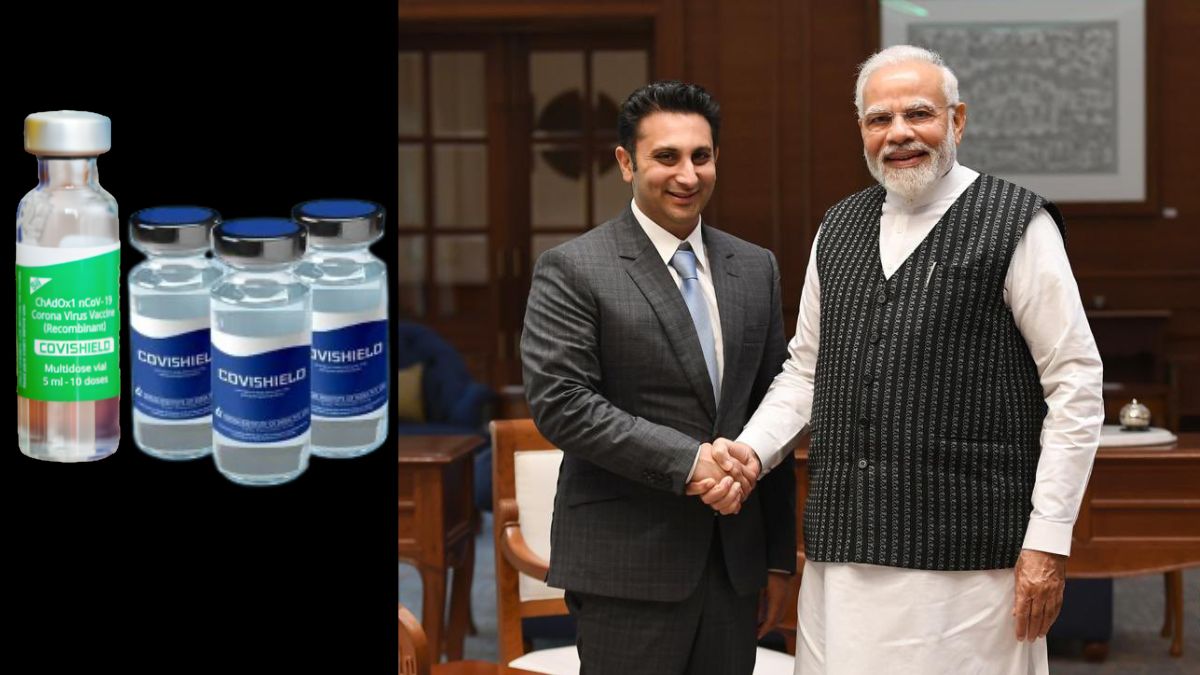
On Saturday 28 November, 2020, Prime Minister Narendra Modi visited the Serum Institute of India to review the Covid-19 vaccine development and met with SII Chairman & Managing Director Dr. Cyrus Poonawalla and CEO Mr. Adar Poonawalla. On January 16, 2021, just a few days after that, SII launched Covishield Coronavirus vaccine in India.
Covishield was originally developed by the joint efforts of the University of Oxford and AstraZeneca (a USA-based pharma company). Serum Institute CEO Adar Poonawalla bought the commercial sub-license from AstraZeneca. There are no official records found for the upfront payment made for the commercial deal, but on multiple occasions Adar Poonawalla stated that SII (Serum Institute) has to pay 50% of its revenue from Covishield sales to AstraZeneca as a royalty fee. A 50% royalty fee on vaccines? Seems shocking, isn’t it? This is the highest royalty fee ever paid by anyone in the history of vaccine transfers. It seems like a more commercial deal rather than a philanthropic arrangement.
In an ideal situation, when one vaccine developer gives a license to another developer in a different country to manufacture the vaccine, the core idea behind it is to cut and save the additional cost of supply chains and distribution. The core idea is to make vaccines available easily and affordably to the lower class.
For example, “Covaxin,” another Coronavirus vaccine developed by the Indian Council of Medical Research (ICMR) along with its subsidiary National Institute of Virology (NIV). The development was a true public-private partnership. In May 2020, the virus strain was transferred to Bharat Biotech, a privately held company based out of Hyderabad, Telangana, and owned by Dr. Krishna Ella and Mrs. Suchitra Ella. The deal was closed at 5% as royalty fees. “ICMR holds rights to claim a 5% royalty on the vaccine.”
50% Royalty Fees is the highest ever in Vaccine Transfer History
Let’s understand it with the “Hepatitis B Vaccine.” In the late 1990s, technology transfer to manufacture the Hepatitis B Vaccine in countries like India, Korea, and Brazil was done with the idea of lowering the vaccine’s price from around $100 to under $0.30 per dose. The vaccine technology transfer has been done with a special note that says royalty rates would add no more than 1% to 5% to production costs, with total royalties ideally not exceeding 1% to 3%.
In another incident, in the late 1990s, scientists at the Indian Institute of Science (IISc), led by P.N. Rangarajan, developed their own recombinant Hepatitis B vaccine under government technology programmes. They transferred this technology to Indian companies including Bharat Biotech, Biological E, and Indian Immunologicals. The companies paid a modest one-time fee of around 15 – 18 lakh rupees and agreed to a low 1% royalty on sales for a limited period, such as five years.
If we check the global history of such vaccine technology transfers, then we see a maximum of 7% royalty has been paid by one vaccine developer to another. Then why Serum Institute’s Covishield technology transfer happened at 50%? Not only this, Prime Minister Narendra Modi himself announced and promoted Covishield.
Covishield by AstraZeneca supplied 3 billion doses to 175 countries and each dose sold between $3 to $8. So, imagine the money involved here. Later it was also discovered that Serum Institute of India donated ₹50.25 Crores to BJP through Electoral Bonds. Same Electoral Bonds that were declared unconstitutional by the Supreme Court of India.
No matter how expensive one dose is, no matter if Adar Poonawala paid Rs 50.25 Crores just to get a nice photo with PM Modi for his tweet. What really matters is one’s life; if any vaccine is saving someone’s life, let’s pay for it. But when it comes to Covishield by AstraZeneca, it was exactly doing the opposite.
Coronovirus vaccines like AstraZeneca, Pfizer and Moderna thease vaccines are always considered as threat by medical experts. For example, AstraZeneca faced legal action in Britain as it admitted in court documents in February 2024 that its Covid vaccine could cause Thrombosis with Thrombocytopenia Syndrome (TTS) in very rare cases. (Read report)
Recently, Dr Peter McCullough at the testimony at the Allison Enquiry said that “Covid Vaccines are the greatest gamble in medical history. Sudden heart attacks are due to Coronavirus Vaccines, majorly AstraZeneca and other mRNA vaccines.” (Read report)
At the time of the Delta Variant, there was an acute shortage of vaccines in India and people who could afford it were ready to buy the shots at any cost. In the Indian black market, people paid as low as 850 Rupees to INR 25,000 for a single shot. Not only this, WHO acknowledged that fake Covid vaccines have also been distributed in the Indian market.
Growth of SII and Adar Poonawala family post Covishield launch
No matter what happens to the people who took the Covishield vaccine, Adar Poonawala’s growth has been remarkable. Even though he had expressed anxiety over losses due to the Indian government’s mandated price of Rs 150 per dose, post-Covishield he expanded into several new ventures. These include Poonawala Fincorp, which was acquired by Magma Fincorp and later rebranded. He also entered the entertainment business by buying a 50% stake for ₹1,000 crore in Karan Johar’s Dharma Productions through Serene Productions. In 2026, he moved into cricket by acquiring a controlling stake in Rajasthan Royals (IPL) along with the Mittal family in a deal valued at $1.65 billion. He further diversified into diagnostics with MyLab Discovery Solutions and into clean energy with Inox Clean Energy. Pre-Covid, Serum Institute of India’s turnover stood at Rs 7,200 crore in 2020-21. It rose sharply to Rs 25,645 crore in 2021-22 and has since remained in the range of Rs 12,000 – 15,000 crore in 2026.
Whether, Covid-19 vaccines were a genuine solution for a illness or it was the biggest gamble in the medical history as said by Dr Peter McCullough or its a jointly operated money making sceheme by leaders in power and pharmaceutical company, But one thing is clear: the way Covid-19 (SARS-CoV-2) virus has been generated and then its spread and then the sudden introduction of several vaccines. Something is not very right.
As Dr Peter McCullough said in his speech at parliamentary hill – “I think the propaganda over this pandemic worked. All these messages came out that no one is safe, and people were entranced in fear and conditioned to undergo mass vaccination.” He was talking about the propoganda behind Cornovirus vaccines.
In the Indian context, Dr Peter’s McCullough statement seems relevant. In a country where it takes around 4 years to get the licence for a cloud-based internet service like Starlink, in the same country one vaccine has been approved by all medical authorities in a few days and promoted by the Prime Minister himself and then sold to masses.
Disclaimer
This article is based on research conducted by the Digpu News team, the views and opinions of the authors, testimonies presented during the Allison inquiry, and reports published by various media outlets. If you have any concerns or objections regarding the content of this article, please write to us at [email protected].