Modi’s New Distraction: How a Transgender Law Amendment Is Being Used to Hide Soaring LPG & Oil Crisis
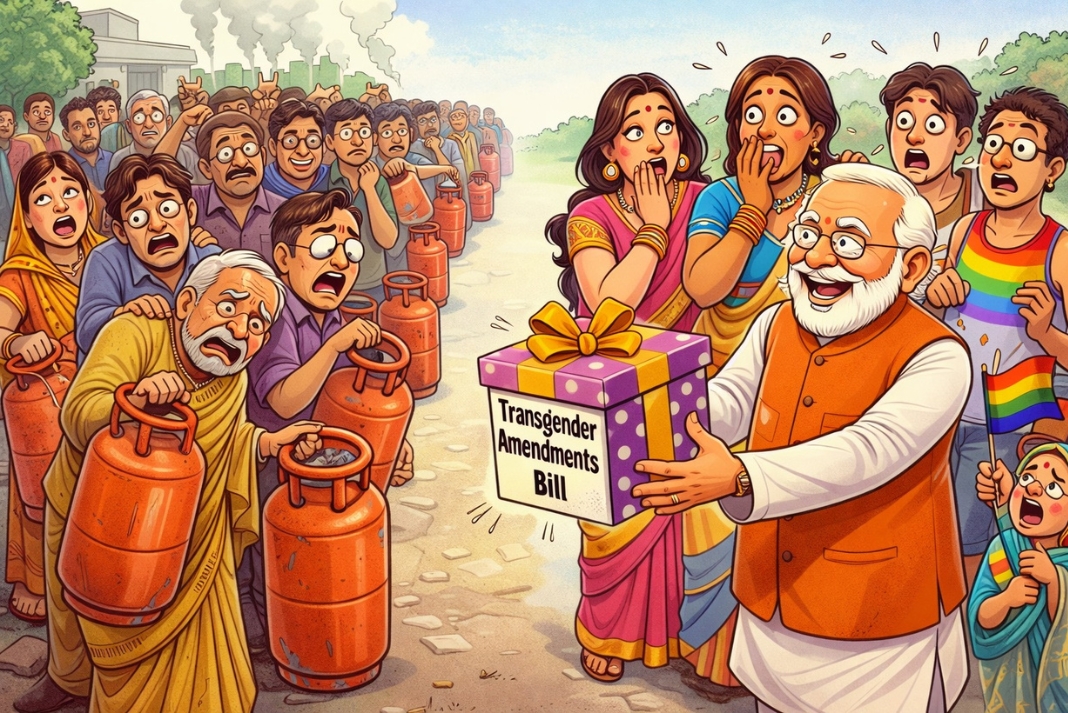
In a move that has left constitutional experts scratching their heads and LPG consumers clutching their wallets, the Modi government has unveiled its latest blockbuster: the Transgender Persons (Protection of Rights) Amendment Act, 2026. And what a masterpiece of political misdirection it is!
For those keeping score at home – and honestly, who can keep track anymore? – the government has officially decided that the best way to handle a global oil crisis is to… redefine who gets to call themselves a transgender person. Genius. Absolutely genius. Why fix gas prices when you can just fix definitions?
First, The Burning Issue Nobody’s Talking About (On Purpose)
Let’s start with the elephant in the room that the government would very much like you to ignore. While Parliament was busy rushing through this amendment bill in record time – bypassing a Supreme Court-appointed advisory committee’s request to withdraw it—India’s commercial LPG cylinder prices were doing what they do best: going up, up, and away.
On April 1, 2026 (the date alone should have told us something), the price of a 19-kg commercial LPG cylinder was hiked by a cool Rs 195.50, bringing the retail cost to a whopping Rs 2,078.50 in Delhi. That’s the second increase within a week and the fourth since January 1, 2026. Meanwhile, oil marketing companies are incurring an “under-recovery” of Rs 380 per domestic LPG cylinder – a number that sounds suspiciously like the amount of money the government is hoping you won’t notice leaving your pocket.
But hey, who needs affordable cooking gas when you can have… a heated national debate about who needs a medical certificate to prove their gender identity? Priorities, people!
The Masterstroke: How to “Protect” Rights by Taking Them Away
Now, let’s talk about this legislative marvel. The government’s official Statement of Objects and Reasons argues that the existing definition of a “transgender person” was “vague,” allegedly making it impossible to identify the “genuine oppressed persons” for whom welfare benefits are intended.
Let’s pause here to appreciate the Orwellian beauty of this phrase. “Genuine oppressed persons.” Because apparently, the government has decided that some oppressed people are more “genuine” than others. It’s like a loyalty program for marginalization – collect enough medical certificates and you too can qualify for the “Premium Oppression” tier!
The amendment does three spectacular things:
One: It removes the right to self-perceived gender identity that the 2019 Act had guaranteed. The Supreme Court’s 2014 NALSA judgment held that gender identity is a matter of personal autonomy and should not require medical proof. But why let a little thing like a Supreme Court ruling get in the way of a good political distraction?
Two: It replaces self-identification with mandatory medical board certification. Yes, you heard that right. A medical board headed by a Chief Medical Officer will now decide your gender. Because nothing says “protection of rights” like a government-appointed committee of strangers poking into your most intimate identity.
Three: It explicitly excludes persons with “different sexual orientations” and “self-perceived sexual identities”. So, if you’re gay, lesbian, or bisexual – sorry, this law isn’t for you. The government has officially declared that your oppression isn’t the “genuine” kind. Better luck next amendment!
The Medical Board: Your Friendly Neighborhood Gender Police
Under the new Act, a transgender person must now obtain certification from a medical board before a District Magistrate can issue an identity certificate. The law also mandates medical institutions to report every gender-affirming surgery to district authorities, raising serious concerns about doctor-patient confidentiality.
Activist Disha Shaikh posed the question that should embarrass every policymaker in the country: “When schemes like Ladli Bahin or Mahila Samman Yojana were introduced, women were not asked to undergo medical tests. Why is the transgender community being subjected to this?”
Excellent question, Disha. The answer, of course, is that women vote in large numbers and the transgender community doesn’t. Politics 101, folks.
The Act also criminalises attempts to “forcibly convert” individuals into the transgender community- a provision so vaguely worded that activists fear it could be misused against families, friends, and community support networks. As one protester put it: “It feels like we have been pushed back 30 years”.
And remember that Supreme Court-appointed advisory committee I mentioned earlier? The one that asked the government to withdraw the bill? Its members noted that the provisions were “against the NALSA judgement,” that reporting gender-affirming care to district authorities was a “complete” violation of privacy, and that certain criminalised acts were already addressed by other laws. The government’s response? Passed the bill anyway, with seven government secretaries conveniently absent from the meeting.
Accountability? Never heard of her.
Meanwhile, in the Real World: States Doin’ Their Own Thing
Here’s where the comedy really kicks in. While the central government is busy building its medical board bureaucracy, some states have decided to… just ignore the whole thing and do the right thing instead.
The Delhi Transgender Persons (Protection of Rights) Rules, 2025, notified in July 2025, explicitly allow transgender persons to obtain a Certificate of Identity based on self-identification, with no medical or physical examination required.
Tamil Nadu’s State Policy for Transgender Persons 2025 affirms the right to gender self-identification without requiring medical certificates and even proposes amending inheritance laws to include transgender and intersex persons.
So we now have a situation where the central government is racing backward while state governments are sprinting forward. It’s like watching a car chase where the central vehicle is in reverse gear on a one-way street. Spectacular, if you enjoy political chaos.
The Numbers Game: 5-10% of India Is LGBTQ+ (But Shhh, Don’t Tell the Government)
Now, let’s talk about the population the government is so keen to “authenticate.” Global studies consistently estimate that LGBTQIA+ communities make up about 5-10% of any society. The UNDP has noted that approximately 10% of any population falls under this umbrella.
In a country of 1.4 billion people, that’s somewhere between 70 million and 140 million individuals. Sociological surveys estimate that anywhere from 5-10% of a population are likely to be lesbian, gay, bisexual, transgender, queer, intersex, or asexual.
The Ipsos Pride Survey provides even more specific numbers: approximately 3% of the Indian population identifies as homosexual (gay or lesbian), 9% as bisexual, 1% as pansexual, and 2% as asexual. That’s 15% right there, folks—and that’s just the people willing to admit it in a survey!
But here’s the kicker: only about 2% of the LGBTQ population in India is open about their identity. The rest remain hidden, forced into silence by a society that has historically treated them as invisible. And now the government’s solution is to… make them even more invisible?
Shashi Tharoor once estimated that assuming the international average of 5% of the population, India is home to 60 million gays and transgenders—one of the largest such populations in the world. That’s 60 million people the government is now asking to prove their “genuine oppression” before a medical board.
Imagine the queue outside the Chief Medical Officer’s office. Pack a lunch, folks. You’re going to be waiting a while.
The Modi Method: Same Playbook, New Edition
Let’s be honest here – this isn’t the government’s first rodeo in the art of distraction. Whenever there’s a crisis that the administration would rather not discuss, magically, a culture war issue appears on the horizon. Demonetization overshadowed by something else? Article 370 creating a distraction? Farm laws needing attention? There’s always another headline ready to steal the spotlight.
This time, the timing is particularly exquisite. The world is in the midst of a war crisis in the Middle East, disrupting energy supplies and sending oil prices soaring. Commercial LPG prices have been hiked multiple times in 2026 alone. Domestic cylinder prices remain “unchanged” only because oil companies are absorbing massive losses—losses that will eventually have to be paid by someone (spoiler alert: it’s you).
So what does the government do? It rushes through a controversial transgender amendment bill that had been sitting in the drawer, bypassing consultations, ignoring a Supreme Court panel’s request for withdrawal, and passing it amid Opposition walkouts. The Bill cleared Parliament on March 25, 2026, and received Presidential assent on March 31 – International Transgender Visibility Day. The irony, as they say, was not lost on anyone except apparently the people in power.
Congress leaders called it a violation of constitutional rights. CPI(M) slammed the government for imposing a “rigid, Brahmanical concept of gender and social order”. Activists termed it “regressive, exclusionary, and unconstitutional”.
But hey – at least nobody’s talking about LPG prices anymore, right?
The Grand Circus: What This Law Actually Does
Let us break down the absurdity in simple terms:
Before the amendment: A transgender person could walk into a District Magistrate’s office, declare their gender identity through a simple affidavit, and receive recognition. No medical tests, no committees, no bureaucratic nightmares.
After the amendment: That same person must now appear before a medical board headed by a Chief Medical Officer, submit to “verification,” obtain a recommendation, and then – and only then – receive a certificate from the DM. And if they’ve had gender-affirming surgery? That procedure gets reported to district authorities, because nothing says “privacy” like mandatory government surveillance of your medical history.
The amendment also narrows the definition of a transgender person to specific socio-cultural identities like kinnar, hijra, aravani, and jogta, or persons with specific “intersex variations” at birth. Trans men and trans women who don’t belong to these traditional communities? Effectively erased from legal recognition entirely.
As activist Raghavi pointed out: “Do they expect everyone to join a Gharana and accept a Guru? Would this mean that any Guru can sign the certificate?”
The amendment also includes a provision criminalizing the “compelling” of anyone to present a transgender identity – a clause so broad that activists fear it could be used to target families, friends, and community networks that support transgender individuals. The government says it’s to prevent exploitation. Critics say it’s a weapon waiting to be misused.
The Real Tragedy Behind the Satire
Now, let me step back from the sarcasm for a moment. Because behind all the political maneuvering and headline-grabbing distractions, there are real people whose lives are being affected.
The transgender community in India has fought for decades for recognition, dignity, and rights. The 2014 NALSA judgment was a landmark moment—the Supreme Court explicitly stated that gender identity is a matter of personal autonomy and should not require medical proof. The 2019 Act was flawed but at least acknowledged the principle of self-identification.
Now, in one swift legislative move, the government has rolled back years of hard-won progress. The community’s response has been heartbreaking: “Give us poison,” some activists said during protests. That’s not hyperbole – that’s despair.
One activist, Manasvi Goilkar, stated bluntly: “We are not seeking amendments – we want the Act withdrawn entirely.” Another, Disha Shaikh, compared it to colonial-era policies that criminalized identity.
And let’s not forget the healthcare professionals caught in the crossfire. Dr. Kanchan Pawar, who has worked with the transgender community for over 15 years, expressed concern that the law’s provisions requiring medical practitioners to report gender-affirming procedures raise “serious issues around doctor-patient confidentiality and privacy”.
This isn’t just bad policy. It’s cruel policy disguised as protection.
The Bottom Line: A Law in Search of a Problem
Here’s the thing about this entire saga: nobody asked for this amendment. The transgender community didn’t ask for it. LGBTQ activists didn’t ask for it. Opposition parties didn’t ask for it. Even the Supreme Court’s own advisory committee asked the government to withdraw it.
The only people who wanted this bill were the ones who introduced it, passed it, and signed it into law. And why? The government’s stated rationale is that the old definition was too “vague” and they needed to identify “genuine oppressed persons” for welfare benefits.
But here’s what the government conveniently ignores: the real problem isn’t that the definition is vague – it’s that welfare benefits for the transgender community are practically non-existent. You don’t need a narrower definition of “genuine oppressed persons” when you’re not actually providing meaningful support to anyone in the first place.
It’s like standing outside a burning building and arguing about the precise definition of “fire.” Meanwhile, the flames are spreading, and the only thing on offer is a seminar on semantics.
So the next time you hear about a controversial new law being rushed through Parliament, ask yourself: what crisis is the government trying to distract us from this time? Because chances are, it’s not the one they’re talking about.
And if you’re wondering whether your LPG cylinder will cost more next month, don’t worry – the government’s medical board is working hard to determine whether you’re a “genuine oppressed person” before they decide whether you deserve subsidized cooking gas.