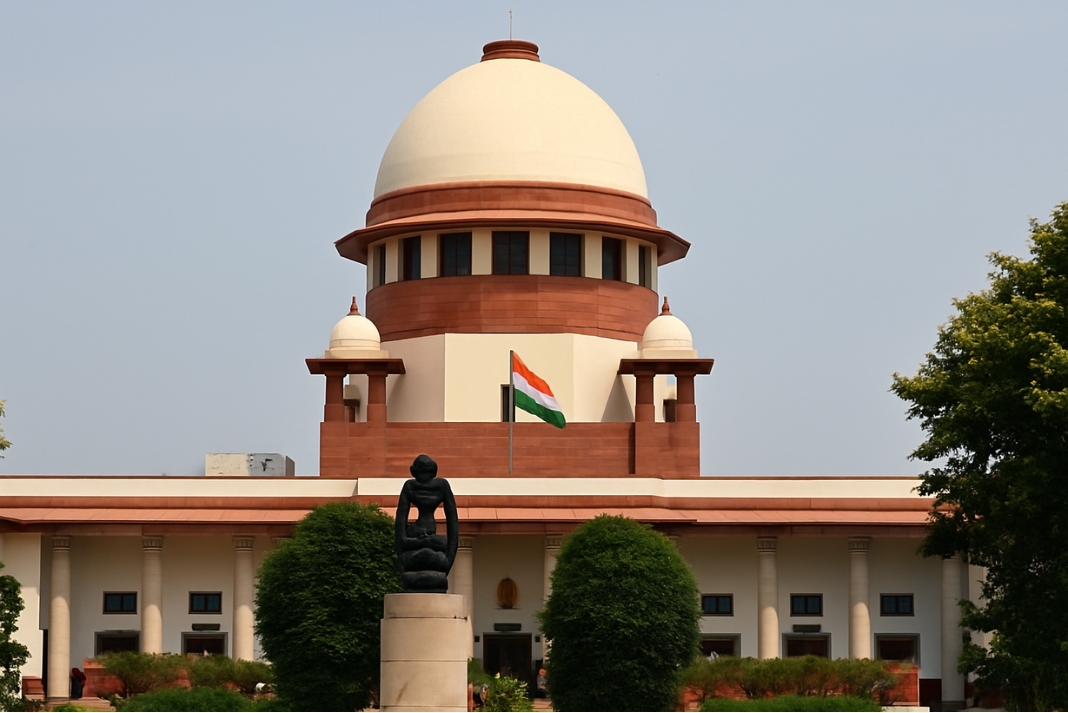
SC Declares Aadhaar a Valid ID for Voter List Inclusion in Bihar, Slams ECI for Ground-Level Non-Compliance
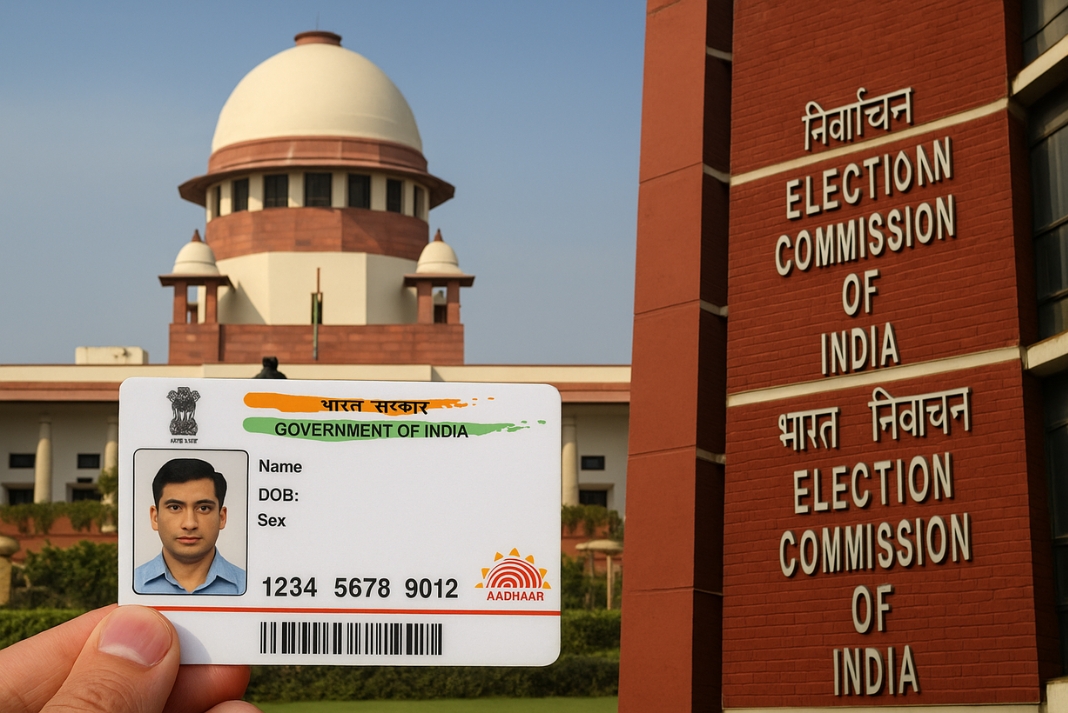
In a landmark ruling on Monday, the Supreme Court directed the Election Commission of India (ECI) to officially recognize the Aadhaar card as the 12th valid identity document for inclusion in Bihar’s revised electoral rolls, ending weeks of legal wrangling and confusion on the ground.
The order comes in the wake of growing concerns that lakhs of eligible voters, many from economically weaker sections, were being excluded from the voters list during the Special Intensive Revision (SIR) exercise due to the ECI’s reluctance to accept Aadhaar as a stand-alone proof of identity.
“Aadhaar is not proof of citizenship, but it is proof of identity. That much is clear under the law,” observed Justice Joymalya Bagchi, part of the two-judge bench alongside Justice Surya Kant.
The bench’s directive puts to rest a contentious debate in which ECI officials on the ground were reportedly refusing to accept Aadhaar, despite multiple prior court orders.
Court to ECI: Get Your House in Order
The court didn’t mince words while expressing dissatisfaction over ECI’s failure to implement its earlier orders. Senior Advocate Kapil Sibal, appearing for the RJD, accused the Commission of defying three Supreme Court directives by continuing to reject Aadhaar at the field level. He even cited a show-cause notice issued to a Booth Level Officer (BLO) for accepting Aadhaar—an incident that clearly illustrated the systemic disobedience.
“If Aadhaar, the most accessible ID in the country, isn’t accepted, this is not inclusion, it’s targeted exclusion,” Sibal argued.
The court echoed these concerns, stating that apart from the passport and birth certificate, none of the 11 documents originally accepted by the ECI were definitive proof of citizenship either. The judgment reinforced that the Aadhaar card, while not a citizenship document, is legally valid as proof of identity under Section 23(4) of the Representation of the People Act.
ECI Pushes Back—Then Relents
ECI’s counsel, Senior Advocate Rakesh Dwivedi, attempted to draw a line between identity and citizenship, arguing that the Commission has the authority to verify an applicant’s citizenship status before enrollment.
But the court swiftly reminded him that such authority has limits—and that all identity documents, including Aadhaar, are susceptible to forgery.
“Any document can be forged. That doesn’t justify a blanket rejection,” said Justice Kant.
Eventually, Dwivedi gave an undertaking that the ECI would issue fresh instructions to all electoral officials by the end of the day, explicitly acknowledging Aadhaar as an acceptable form of identification for voter list inclusion.
From Confusion to Clarity
The ruling is the culmination of a long series of hearings, stretching back to July. The Court had already directed the ECI multiple times, on July 10, July 28, and August 22, to consider Aadhaar as part of the accepted identity documents for voter inclusion. But reports kept surfacing of BLOs ignoring those orders.
The issue escalated when petitioners claimed that 65 lakh voters were likely to be excluded from Bihar’s rolls, with two citizens even being declared dead in error.
After today’s order, the Court formally directed the ECI to treat Aadhaar as the 12th document for identity verification purposes, alongside the existing eleven. The Commission was also instructed to allow verification of Aadhaar’s authenticity by officials, but not to use it to question citizenship.
What This Means Going Forward
Voters in Bihar can now submit their Aadhaar cards as a stand-alone identity document for inclusion in electoral rolls.
ECI must issue new instructions immediately to ensure compliance at the grassroots level.
Aadhaar remains a document of identity – not citizenship – and cannot be the basis to deny voter registration.
Verification of authenticity is allowed, but arbitrary rejection is not.
The Court’s firm tone and detailed ruling are seen as a pushback against bureaucratic opacity and operational resistance from the ECI, as well as a win for voter inclusion in one of India’s most politically sensitive states.
Political and Legal Implications
The ruling has implications beyond Bihar. It may influence how electoral revisions are conducted in other states and how the Aadhaar card is treated in the voter registration process nationwide.
A separate plea by Advocate Ashwini Kumar Upadhyay is still pending, which seeks a nationwide SIR. If the Court eventually mandates Aadhaar as an identity document across all states, today’s ruling could become a precedent for electoral reforms across the country.
As things stand, the battle for fair voter inclusion in Bihar just saw a major legal breakthrough, and one that may finally reach the ground.