50% Tariff Shock: How Trump’s Trade Move is Shaking Indian Industry
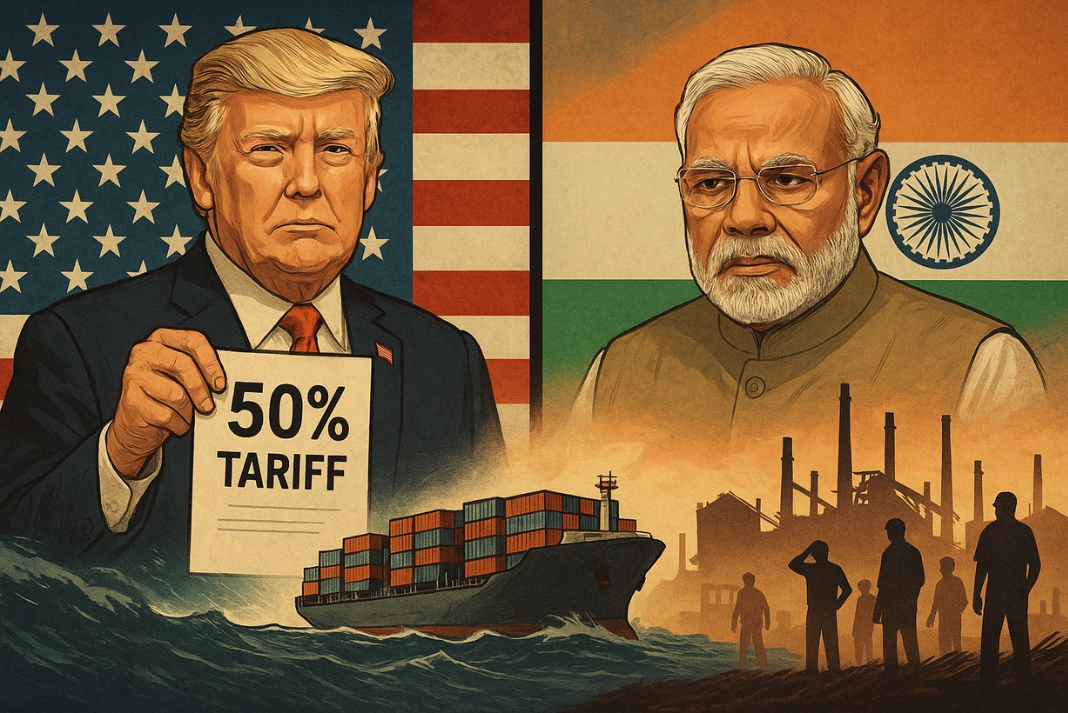
The abrupt implementation of a 50% tariff on Indian exports to the United States has unsettled the nation’s business community, leaving small traders, exporters, and workers facing an uncertain future. What was previously regarded as a mere threat has now become a harsh reality, with its ripple effects starting to manifest across India’s labour-intensive sectors.
India Feels the Heat
The U.S. administration’s move signals a blunt message to the world: Washington will act solely in its own interest, even if it means sidelining trade negotiations under the WTO framework. Competitors such as China, Bangladesh, Vietnam, and Pakistan are subject to tariffs averaging between 18% and 20%. In contrast, India has been singled out for a staggering tariff of 50%.
For cities like Surat, Noida, and Tiruppur, hubs of diamonds, textiles, and garments, the impact is devastating. Industry bodies warn that export orders have dried up overnight, leaving workshops and factories on the verge of closure. “We are looking at job losses in lakhs. Entire clusters may shut down if relief does not come quickly,” one exporter association remarked.
From Diamonds to Textiles: Sectors in Crisis
The tariff applies most heavily to sectors where India has long been competitive – textiles, gems and jewelry, leather, machinery, furniture, and seafood. Together, these contribute nearly $47–48 billion annually to India-U.S. trade.
Already, diamond workshops in Surat are scaling back operations, while garment factories in Tiruppur have reported production halts. Exporters in the seafood industry, which once shipped 40% of its produce to the U.S., now warn of steep declines.
Meanwhile, pharma, automobiles, and electronics have been spared from the harshest blow, but experts caution that overall demand will still fall, with ripple effects across the economy.
Political Fallout
The tariff shock has sparked a debate regarding India’s foreign policy management. Prime Minister Narendra Modi previously made significant efforts to cultivate a relationship with Donald Trump, campaigning for him in the U.S. and hosting him in India. However, the ties once described as a “close friendship” now seem strained, with reports indicating that even direct communication between the two leaders has deteriorated.
Critics argue that New Delhi misread Trump’s style of politics and failed to anticipate his hardline trade stance. “The government did not know how to deal with Trump. Their missteps are now costing Indian businesses dearly,” said an economist.
The Larger Dilemma
The U.S. move is accompanied by conditions. Washington has consistently urged India to decrease its trade with Russia, especially regarding oil and defence equipment. However, with almost 50% of India’s defence arsenal originating from Russia, New Delhi faces significant challenges in reducing these ties.
On the agricultural front, Washington has been advocating for broader access for American farm goods, including genetically modified products. In India, where 85% of farmers cultivate less than five acres, opening its markets to heavily subsidised U.S. agribusiness could lead to significant public unrest – a reality highlighted by the farmer protests of recent years.
What Lies Ahead?
Experts warn that the tariff hike will render Indian exports nearly 30% more expensive than those from competitor nations, making trade with the U.S. “virtually impossible” in many sectors. Industry groups are appealing for subsidies, but such large-scale support may be beyond the government’s financial capacity.
The broader worry is the impact on jobs and demand. With production slowing, unemployment could rise, weakening domestic consumption further. “Unless the government shifts its focus from big corporates to small and medium industries, and boosts rural income, demand will keep falling,” according to a leading economist.
For now, the tariff storm has exposed the fragility of India’s export model. The very sectors that employ millions are at risk, while the political narrative of strong global partnerships has given way to uncertainty.
As one exporter bluntly put it: “We don’t need slogans. We need survival.”