From Naseeruddin Shah to Anupam Kher: How Politics Is Dividing the NSD Fraternity
From Naseeruddin Shah and Anupam Kher to Piyush Mishra, a growing series of public confrontations among National School of Drama graduates raises uncomfortable questions about artistic freedom, political allegiance and the fading spirit of a shared institution.
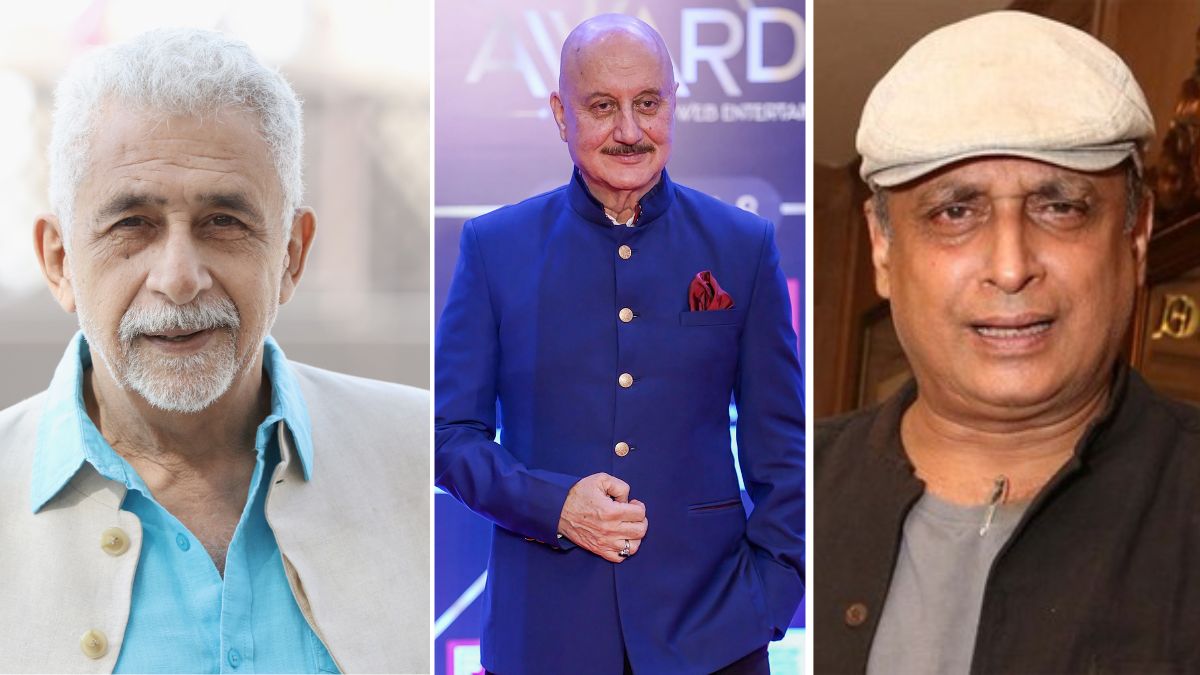
There was a time when the National School of Drama (NSD) represented something larger than the individuals who walked through its doors. It was a place where aspiring actors came to understand the discipline of performance, where different artistic temperaments learned to coexist, and where the pursuit of theatre mattered more than the political convictions of those practising it.
Founded in 1959 under the Sangeet Natak Akademi, with institutional support from Pandit Jawaharlal Nehru, who served as its president, the founders envisioned the National School of Drama as a centre for serious theatrical education.. The institution gained independence in 1975, gradually establishing itself as one of India’s most respected training grounds for actors, directors and theatre practitioners.
Its promise was straightforward: nurture talent, sharpen artistic sensibilities and produce practitioners committed to their craft.
And it did precisely that.
Over the decades, NSD became associated with some of the most recognisable names in Indian cinema and theatre. Pankaj Kapur, Irrfan Khan, Anupam Kher, Nawazuddin Siddiqui, Pankaj Tripathi and Manoj Bajpayee are among the celebrated actors associated with its legacy. Its 1973 batch produced two particularly remarkable talents, Naseeruddin Shah and the late Om Puri, both of whom went on to earn recognition far beyond India’s borders.
These were artists whose performances could command attention without requiring political endorsements or ideological declarations.
Yet, more than six decades after its establishment, the institution’s public legacy is increasingly being discussed through a different lens.
The conversations are no longer exclusively about theatre, cinema, acting techniques or artistic excellence. Instead, the names of its celebrated alumni increasingly appear in headlines involving political disagreements, personal accusations and public confrontations.
Something has changed in the relationship between the institution’s graduates.
And the question is whether the politics of the present is beginning to overshadow the artistic fraternity they once shared.
When disagreements move from the stage to the streets
A new controversy erupted in October 2026, when actor Piyush Mishra, an NSD alumnus from the 1986 batch, released a video criticising veteran actor Naseeruddin Shah.
The immediate trigger was Shah’s participation in CJP’s protest. Mishra questioned what he described as selective activism, arguing that Shah spoke openly on certain political and social issues while remaining silent on others, including matters involving a pilot’s bravery and student protests.
Naseeruddin Shah meeting Abhijeet Dipke
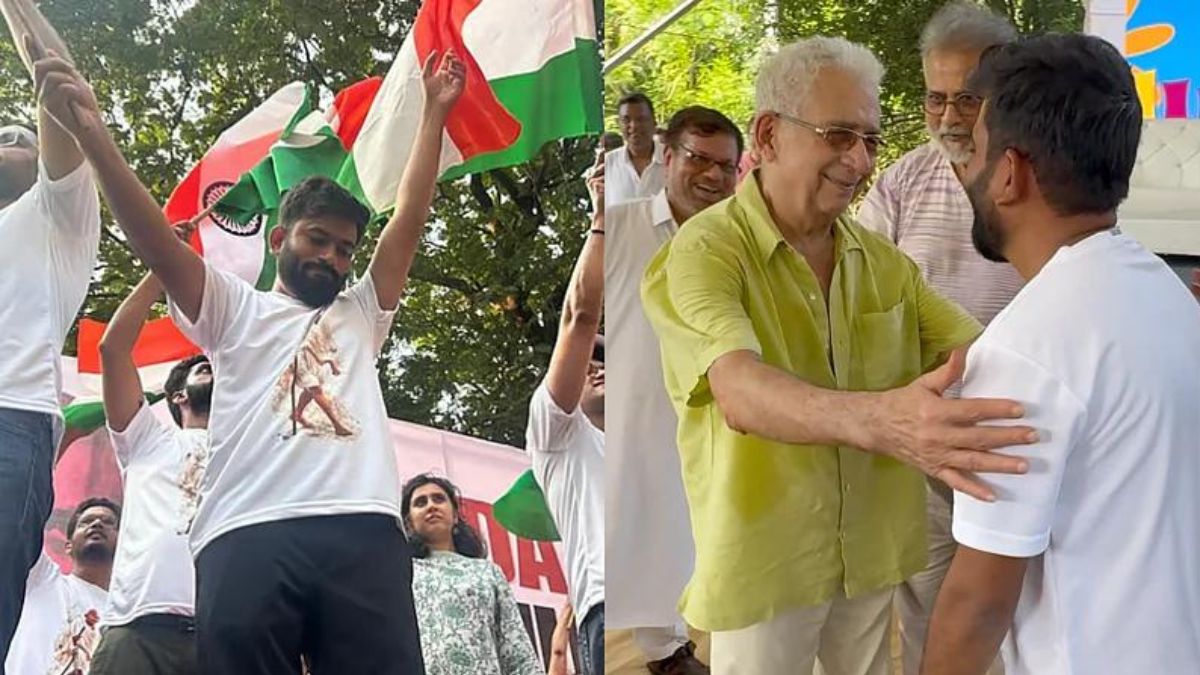
Mishra also revisited Shah’s earlier observation that students had taught him more than his formal training at NSD or the Film and Television Institute of India (FTII).
The video attracted considerable attention, turning what might have remained a disagreement between two individuals into another public confrontation involving prominent members of the NSD fraternity.
There is, of course, nothing unusual about artists disagreeing with one another. In fact, disagreement is often essential to creative expression. Theatre itself is built around questioning established ideas, challenging authority and exploring uncomfortable truths.
But there is a distinction between debating ideas and turning professional disagreements into personal battles.
The distinction appears increasingly difficult to maintain.
Piyush Mishra’s criticism:
Naseeruddin Shah and Anupam Kher: An old disagreement that refuses to disappear
Perhaps no relationship better illustrates the growing political divide among NSD’s prominent alumni than the prolonged public disagreement between Naseeruddin Shah and Anupam Kher.
Their differences became particularly visible in early 2020, when Shah, while discussing the political atmosphere surrounding the JNU protests and Kher’s public support for the government, described his former contemporary as a “clown”. He also used the expression “sycophantic nature” while questioning Kher’s political positions, suggesting that people who had known him during his NSD and FTII days would recognise the traits he was describing.
Naseeruddin Shah’s remarks about Anupam Kher (January 2020)
Anupam Kher did not take the criticism lightly.
In a sharply worded social media video, he responded by questioning Shah’s personal contentment despite his professional achievements. He also made remarks suggesting that Shah’s judgment had been affected by substance use.
What followed was not simply an exchange of opposing political opinions. It became a deeply personal confrontation between two actors whose careers had emerged from India’s shared institutional and artistic ecosystem.
Anupam Kher’s video response to Naseeruddin Shah
The disagreement resurfaced repeatedly in public conversations over the following years, including in 2025 and 2026.
There was, however, a moment that suggested the possibility of reconciliation. Kher later spoke about meeting Shah at a memorial service, where the two reportedly embraced and Shah offered a brief apology.
Yet, in the age of social media, old arguments rarely disappear. Videos, interviews and fragments of earlier exchanges continue to circulate whenever either actor takes a position on a political issue.
The past becomes ammunition for the present.
And two celebrated actors, whose work once represented the strength of Indian performance, continue to be discussed as much for their disagreements as for their achievements.
When the institution itself became part of the controversy
The tensions surrounding NSD are not limited to individual disagreements.
In 2021, the institution found itself at the centre of a collective protest involving artists, alumni, former faculty members and academics.
More than 200 signatories, including prominent theatre personalities such as Anuradha Kapur, Seema Biswas, M.K. Raina and Sudhanva Deshpande, objected to religious festival imagery being shared through NSD’s official social media accounts under the chairmanship of Paresh Rawal.
Their objection was rooted in the belief that a publicly funded national cultural institution should maintain an inclusive and secular institutional identity rather than appear to endorse particular religious messaging.
They demanded the removal of the posts and questioned the direction in which the institution was moving.
This was an important distinction. The disagreement was not merely about individual political preferences. It concerned the identity, independence and responsibilities of an institution established to serve India’s diverse cultural traditions.
The episode also demonstrated that the anxieties surrounding NSD extended beyond the personal relationships of its alumni.
The institution itself had become part of a larger political conversation.
Om Puri and the price of an uncomfortable opinion
Perhaps the most painful reminder of how political controversies can engulf an artist remains the episode involving the late Om Puri.
In the aftermath of the September 2016 Uri attack, India witnessed intense public debate over whether Pakistani artistes should be allowed to work in the country.
During a television discussion on the subject, Puri made remarks about Indian soldiers that many viewers considered deeply insensitive. Statements questioning who had asked soldiers to join the Army, along with his provocative references to suicide bombers, were clipped and circulated widely.
The reaction was immediate.
A police complaint was filed, criticism poured in from several quarters, and even fellow actors, including Anupam Kher, publicly disagreed with his remarks.
Puri subsequently apologised repeatedly. He expressed regret and even said that he was willing to face punishment from the Army.
The controversy followed him during the final months of his life. He died in January 2017.
It would be unfair to suggest that every criticism directed at an artist is politically motivated. Public figures, particularly those discussing matters involving national security and the armed forces, must expect their words to be examined.
But the episode also revealed something about the shrinking space between an individual’s opinion, public outrage and political interpretation.
An artist could make a poorly expressed argument, apologise for it and still find that the controversy had acquired a life of its own.
In such an atmosphere, the possibility of a thoughtful conversation becomes increasingly difficult.
When political conviction becomes a measure of artistic credibility
Anupam Kher’s position in this debate is particularly interesting because his public identity has become closely associated with his political convictions.
A Padma Bhushan recipient, Kher has consistently expressed support for the BJP and Prime Minister Narendra Modi. He has repeatedly maintained that he considers himself a nationalist rather than a politician, arguing that support for the country should not automatically be interpreted as allegiance to a political party.
He also served as chairman of the Film and Television Institute of India between 2017 and 2018.
His family has had a more direct connection with electoral politics. His wife, Kirron Kher, joined the BJP in 2009, won the Chandigarh Lok Sabha constituency in 2014 and 2019, and served as a Member of Parliament. She was not renominated for the 2024 general election, having cited health considerations following treatment for multiple myeloma.
These associations have inevitably influenced how Kher’s public statements are interpreted by his critics.
For some, his support for the government represents an individual’s political conviction. For others, it raises questions about proximity to power and the relationship between cultural personalities and political establishments.
But there is an important principle that should not be lost in this debate: an actor’s political opinion does not automatically determine the quality of his artistic work.
The same standard must apply to Shah, Mishra, Kher and every other artist.
An individual’s political position may be questioned, challenged or criticised. But reducing an entire artistic career to political allegiance diminishes the very freedom that allows artists to think independently.
The bigger casualty may be the spirit of NSD
The National School of Drama has never existed outside politics. Cultural institutions are inevitably influenced by the governments that fund them, the policies that shape them and the ideological debates of their times.
Nor should its alumni be expected to share identical political beliefs simply because they studied at the same institution.
Naseeruddin Shah is entitled to his convictions. Anupam Kher is equally entitled to his. Piyush Mishra can question Shah’s positions, just as Shah can question those of others. Om Puri, too, had the right to express an opinion, even when that opinion attracted severe criticism.
Artistic freedom cannot mean freedom only for those whose opinions we agree with.
But there is a deeper concern here.
When artists who once shared classrooms, rehearsal spaces and professional struggles increasingly encounter one another through public accusations, political labels and social media confrontations, something more significant than individual relationships is at stake.
It is the idea of a shared artistic community.
An institution like NSD should be remembered for the performances it helped create, the actors it trained, the theatre movements it influenced and the cultural conversations it encouraged.
Its graduates should be able to disagree without having to disown their common history. They should be able to challenge governments without questioning one another’s right to hold different convictions. And they should be able to defend their political beliefs without turning every disagreement into a referendum on another artist’s character.
The real danger is not that NSD alumni disagree. It is that the disagreements themselves are gradually becoming more prominent than the work that brought them recognition in the first place.
A school built to nurture performers cannot control what its graduates believe once they leave its classrooms. Nor should it try to.
But its legacy deserves better than to be reduced to a continuing contest of political loyalties.
The National School of Drama was established to teach people how to inhabit different characters, understand different human experiences and tell stories that make audiences think.
Perhaps its most celebrated alumni could take a lesson from that original purpose.
They do not have to agree with one another. They do not even have to like one another.
But they should be able to recognise that before they became political voices, public personalities or national talking points, they were part of the same artistic journey.
NSD was built to create artists, not political camps. Its greatest legacy should remain the work they leave behind, not the battles they wage against one another.


