Chinese Scientists Warn Warming Glaciers Could Trigger More Frequent Cascading Disasters in Nepal and China
Scientists warn that as global temperatures rise, destabilized Himalayan glaciers could unleash more frequent and destructive cascade disasters across the Nepal-China border.
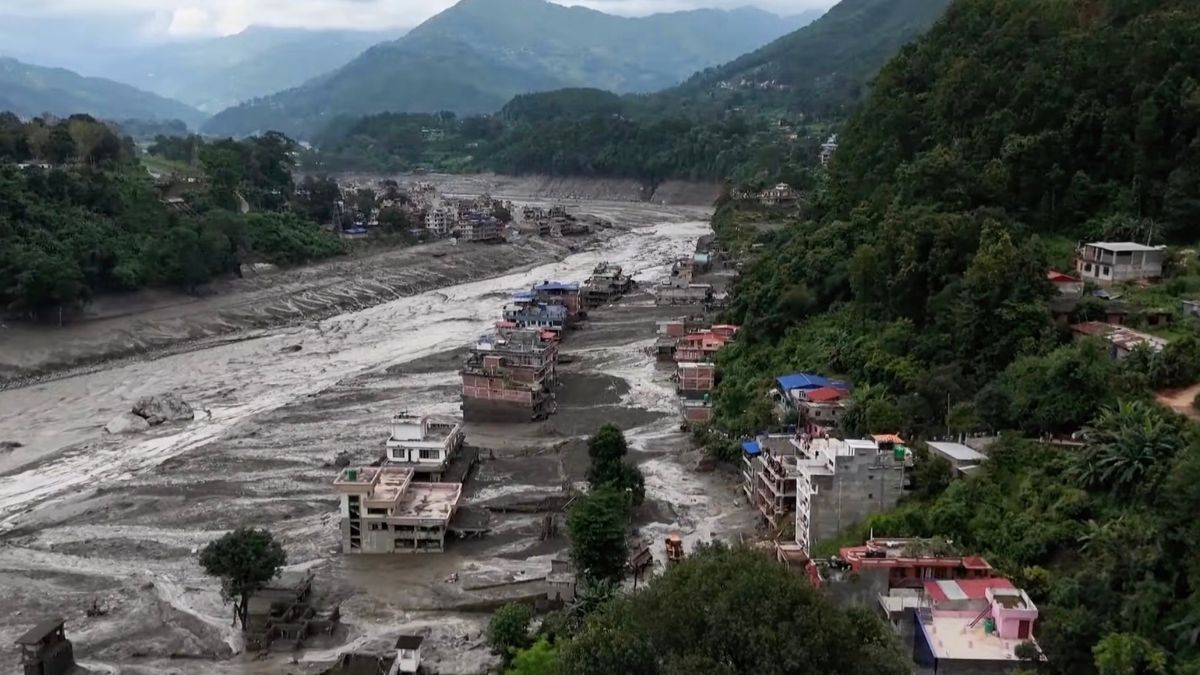
A devastating glacier collapse triggered a cross-border flood that has killed over a thousand people in Nepal and China. Chinese scientists have now issued a stark warning: as global warming further destabilizes glaciers on the Qinghai-Tibet Plateau, similar disasters could become more frequent and trigger increasingly destructive cascading effects.
The August 26 Catastrophe
On August 26, 2026, at approximately 10:52 am, a glacier on the northern slope of Mount Langtang Lirung in Nepal broke off at an elevation of around 5,200 meters. The ice and rock rapidly plunged to approximately 4,000 meters, scouring the mountainside and generating a massive debris flow. After surging at high speed for about 22 kilometers, it reached the Gyirong Port in China’s Xizang Autonomous Region at an elevation of approximately 1,800 meters in just seven minutes.
The destruction was staggering. According to Nepal’s National Disaster Risk Reduction and Management Authority, the death toll reached 1,204 by September 2, with 4,216 people still unaccounted for. Approximately 1.6 million people in Nepal’s Rasuwa and Nuwakot districts were directly affected. The floods completely swept away 41 concrete bridges and damaged four others; in Nuwakot alone, 1,267 houses were completely destroyed and another 1,253 partially damaged. On the Chinese side, 21 deaths and 541 people were reported missing.
The disaster was so powerful that the U.S. Geological Survey initially mistook it for a 4.4-magnitude earthquake before revising the assessment to a flood equivalent to a magnitude 5.2 event.
The Scientific Warning
In the wake of this catastrophe, Chinese scientists have issued a stark warning: warming glaciers could trigger more frequent cascading disasters across the region.
Gao Rong, deputy director of China’s National Climate Centre, told a press conference on September 2 that global warming is accelerating the melting of mountain glaciers worldwide. “Mountain glaciers in China are concentrated mainly on the Qinghai-Tibet Plateau and surrounding areas. Against a backdrop of a warmer and wetter climate, glaciers across the region are generally undergoing accelerated melting,” Gao said.
The data paints a sobering picture. According to the Chinese Glacier Inventory, glacier coverage on the Qinghai-Tibet Plateau has shrunk by approximately 24 percent over the past 60 years, with some 7,000 small glaciers disappearing entirely. The glacier area has shrunk from 61,000 to 39,000 square kilometers over this period. In the southern part of the plateau, particularly in the Himalayas, the reduction is even more severe, reaching approximately 40 percent.
As glaciers melt, glacial lakes are rapidly expanding. There are now over 14,000 glacial lakes on the Tibetan Plateau, with a total area exceeding 1,100 square kilometers. Chinese scientists note that more than 100 glacial lakes in the Himalayas pose a high level of natural hazard risk.
The Cascade Effect
The August 26 disaster was not a single event but a classic example of what scientists call a “cascade effect,” a chain reaction where one hazard triggers another, amplifying destruction at each step.
Second Tibetan Plateau Scientific Expedition team leader and Chinese Academy of Sciences academician Yao Tandong explained that the core trigger was an ice avalanche in Nepal. From a scientific perspective, this disaster exhibited a typical cascading effect: once the ice avalanche occurred, the energy propagated downward along the valley, amplifying at each stage. The further downstream the disaster traveled, the more powerful its destructive force became and the more prominent the secondary risks.
Gao Rong warned that climate warming has altered the dynamic characteristics of glaciers, leading to rising ice temperatures, faster glacier flow, and more frequent surges. Since the beginning of the 21st century, particularly since 2010, ice avalanche events in high-altitude mountainous regions around the world have been on the rise. “Glacier-related disasters could become more frequent and trigger cascading effects that amplify the scale of destruction and expand their impact,” he warned.
A “Ticking Time Bomb”
The threat extends far beyond this single event. An international research team led by the University of Portsmouth identified over 3,100 “surge-type glaciers” worldwide that could trigger floods and avalanches. Approximately 50.5 percent of these surge-type glaciers are concentrated in High Mountain Asia, including the Tibetan Plateau, the Himalayas, and the Karakoram Range. Scientists have identified 81 glaciers posing the greatest threat, mostly in the Karakoram Range, with densely populated villages, roads, bridges, and hydropower facilities located downstream.
University of South Florida geology professor Jason Gulley noted that dozens of “glacier collapses” have occurred along the China-Nepal border since the 1900s. He described Nepal’s melting glaciers as a “ticking time bomb” and warned that if carbon emissions are not curbed, up to 75 percent of existing glaciers in Asia’s high mountain regions could disappear by 2100 due to rising temperatures.
A Shared Responsibility
Nepal’s Prime Minister Balendra Shah has urged the international community to recognize the Bhotekoshi flood as a warning of the growing climate risks confronting the Himalayan region. “The incident is a serious indication that the risks we face in the Himalayan region are increasing,” Shah told parliament. “Climate change is a global problem. Mitigating and managing its impacts is a shared responsibility of the international community.”
Both Nepal and China have emphasized the need for joint monitoring and information sharing. China has already stepped up cross-border support, sending emergency supplies and DNA identification experts to Nepal, while Chinese research institutions continue to monitor glaciers and glacial lakes using high-resolution satellite remote sensing and drone technology.
As the United Nations Environment Programme warned on September 2, global temperatures are set to cross the 1.5°C threshold within the next few years, pushing climate risks and impacts to increasingly dangerous levels. For the Himalayan region, and the hundreds of millions of people who depend on its rivers, the warning from Chinese scientists could not be more urgent.