An American in the Land of Gandhi’s India – Satyananda Stokes
In 1916, Samuel Evans Stokes introduced American Delicious apple varieties to the Shimla Hills, setting in motion an agricultural revolution that transformed the livelihoods of generations of Himalayan farmers.
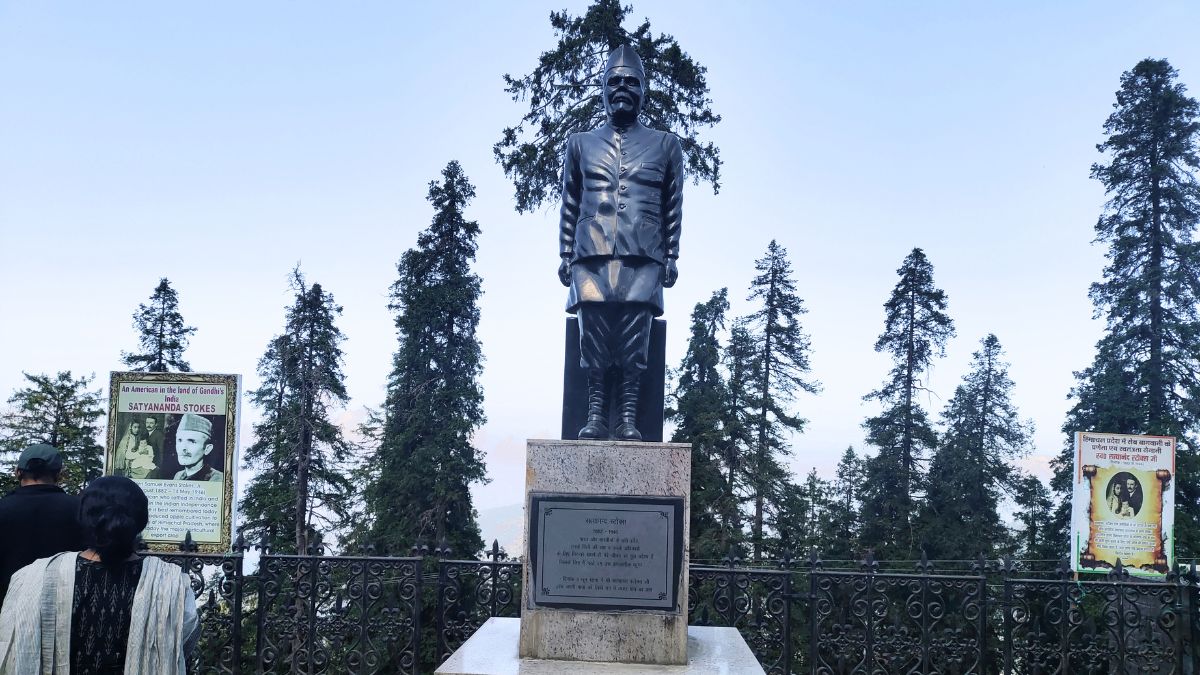
Narkanda, Himachal Pradesh: It was an afternoon during my journey towards Tabo Monastery through Reckong Peo. We had stopped for lunch at Narkanda, a small hill town along the old Hindustan–Tibet road.
Near the main road, not far from the bus stand, I noticed a small memorial surrounded by tall Himalayan trees.
At its centre stood a full-length statue of a man dressed in traditional Indian attire. A commemorative plaque was fixed to the stone pedestal beneath it, while information boards on either side displayed his photographs and explained his contribution to the region.
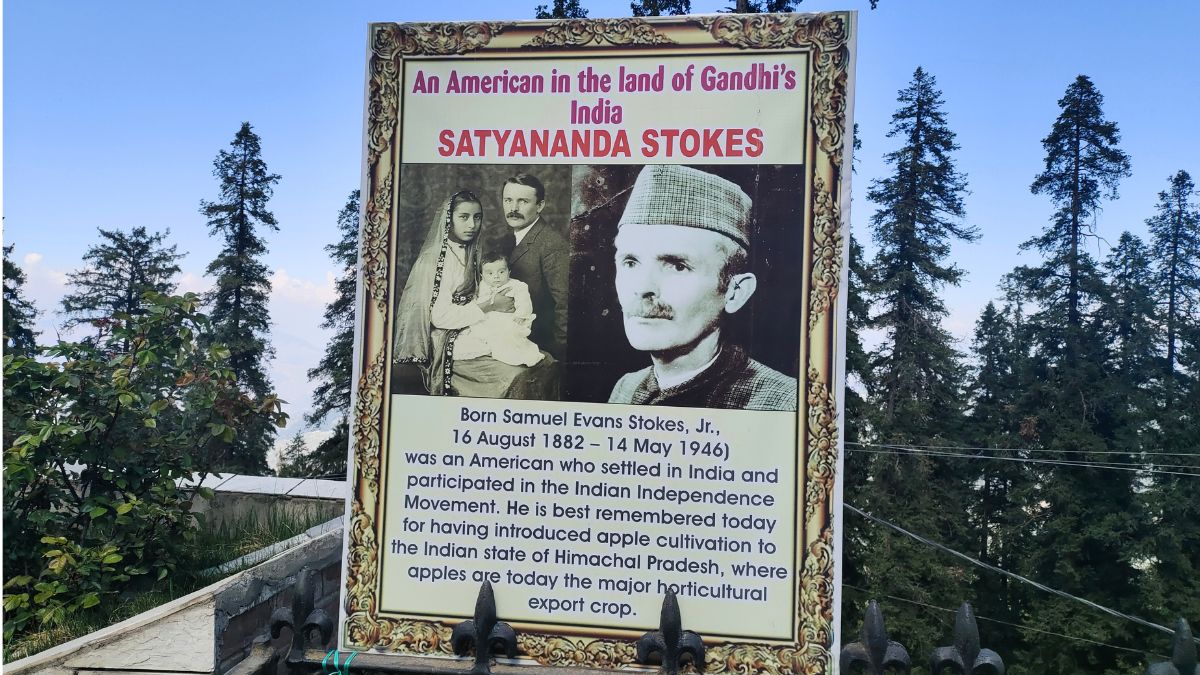
One of the boards carried an interesting description: An American in the Land of Gandhi’s India — Satyananda Stokes.
His name was Samuel Evans Stokes Jr., an American born in Philadelphia on 16 August 1882.
I had travelled through Himachal Pradesh before and knew about its famous apples. But standing before that statue, I found myself wondering how an American had become such an important part of the state’s history.
What had he done to deserve a memorial in this small Himalayan town?
The answer goes back to 1916, when Stokes introduced American Delicious apple varieties to the Shimla Hills, helping lay the foundation of an agricultural transformation that would change the lives of generations of mountain farmers.
But the story of Himachal’s apples began even earlier.
Before apples became Himachal’s identity
Today, apples are among the most recognisable products of Himachal Pradesh. But a hundred years ago, the agricultural economy of the upper Shimla Hills depended largely on traditional crops.
Farmers cultivated grains and other produce, often on small mountain holdings. Difficult terrain, limited transport and poor access to larger markets made commercial agriculture challenging.
Apples were not entirely unknown in the Himalayas. British officers had already experimented with apple cultivation in Kullu during the nineteenth century.
However, these early experiments had not created the large commercial apple industry that would emerge in Himachal over the following decades.
That transformation began taking shape when an American named Samuel Stokes recognised an opportunity in the climate and soil of the Shimla Hills.
An American who saw something different in the mountains
Stokes had arrived in India in 1904, initially to work among people suffering from leprosy at Sabathu, near Shimla.
He came from a financially comfortable family in Philadelphia. His father was associated with a successful elevator-manufacturing business, and Samuel had opportunities that many young Americans of his generation could only imagine.
Yet he chose to remain in India.
Over time, he developed a close relationship with the people of the hills and eventually established his home at Barobagh, near Thanedhar.
Living among farming families, he became increasingly interested in their economic difficulties.
He believed the mountains had the potential to produce something more valuable than the traditional crops on which many households depended.
And he began looking towards his home country for a possible answer.
The American apples that changed Kotgarh
In the early twentieth century, American nurseries were developing and promoting new varieties of apples.
Among the most successful was the Delicious family of apples marketed by Stark Brothers, a nursery business based in Missouri, United States.
Stokes believed these varieties could thrive in the cooler climate of the Shimla Hills.
Around 1916, he planted American Delicious apple saplings at his Barobagh estate in the Thanedhar–Kotgarh region.
It was a small agricultural experiment, but its consequences would be enormous.
The trees grew, and over the following years their fruit demonstrated the commercial potential of the region.
Unlike some of the older apple varieties, the American Delicious apples offered qualities that made them attractive to consumers.
They were appealing in appearance and flavour, creating new opportunities for farmers to sell their produce beyond the immediate neighbourhood.
But Stokes did not confine the experiment to his own property.
He wanted the farmers to grow apples, not just himself
Perhaps the most important part of Stokes’s contribution was his willingness to encourage neighbouring farmers to adopt apple cultivation.
Historical accounts describe him sharing plants and knowledge with local growers, persuading families to consider orchards as a long-term investment.
This was not an easy decision for poor mountain households.
An apple tree takes years to produce a commercially useful harvest. Farmers who depended on seasonal crops could not simply abandon their traditional livelihoods and wait for orchards to mature.
Stokes’s work helped demonstrate that apple farming could succeed in the local conditions.
Gradually, other growers began planting trees.
The process was slow. Large-scale commercial expansion came much later, especially in the decades following Indian independence.
By then, however, the foundation had been laid.
Another important chapter: Golden Delicious apples
The story did not end with the first Red Delicious trees.
In the early 1920s, Golden Delicious planting material also reached the Stokes estate from the United States.
According to historical accounts, his wife Agnes helped plant some of the new saplings while Samuel was imprisoned for his participation in India’s freedom struggle.
It is an extraordinary detail.
While the American who had made India his home was confronting British colonial rule, his family continued the agricultural work that would eventually support thousands of livelihoods.
The contribution of Agnes deserves recognition alongside that of her husband.
Over time, the region became associated with both Red Delicious and Golden Delicious varieties, and later generations of farmers expanded into many more apple cultivars.
From a few trees to an agricultural economy
The real apple revolution unfolded over several generations.
As orchards matured and more farmers entered the business, apple cultivation spread from the Kotgarh–Thanedhar belt into other suitable parts of Himachal Pradesh.
Road construction, improved transportation, horticultural research, packaging and access to markets all contributed to this expansion.
By the second half of the twentieth century, apples had become a major source of income for families in the upper hills.
The economic effects went beyond orchard owners.
Apple cultivation generated work for labourers, transporters, packaging suppliers, traders and other businesses connected to the agricultural economy.
Income from horticulture also helped families invest in homes, schooling and better living conditions.
Stokes did not single-handedly create this entire system. Generations of local farmers, researchers, workers and entrepreneurs played essential roles in its development.
But his early experiment helped establish the potential that others would turn into a major industry.
A legacy that remains visible today
Samuel Evans Stokes died on 14 May 1946, a year before India achieved independence.
He did not live to see the full transformation of Himachal’s apple economy.
The region changed enormously in the decades that followed his death. Orchards expanded, new varieties arrived, and apple-growing communities became closely identified with the state’s agricultural success.
More than a century after the first American Delicious trees were planted at Thanedhar, the name Samuel Stokes is still remembered by farmers and local communities.
Yet outside Himachal Pradesh, relatively few people know his story.
That was what made the photograph at Narkanda so remarkable.
I had stopped there for lunch, expecting little more than a break in a long mountain journey.
Instead, I discovered the story of an American whose agricultural experiment helped change the economic future of an Indian region.
The photograph remains a reminder that some of the most important transformations begin not with enormous government projects or industrial investments, but with someone recognising an opportunity and sharing it with the people around him.
And in the hills of Himachal Pradesh, that opportunity began with a handful of apple trees.