He Had No Home, No Owner and No Name. Then This Indian Dog Walked Across America
From the Streets of Kolkata to Washington: The Extraordinary Journey of Aloka, the Peace Dog Who Walked Across America.
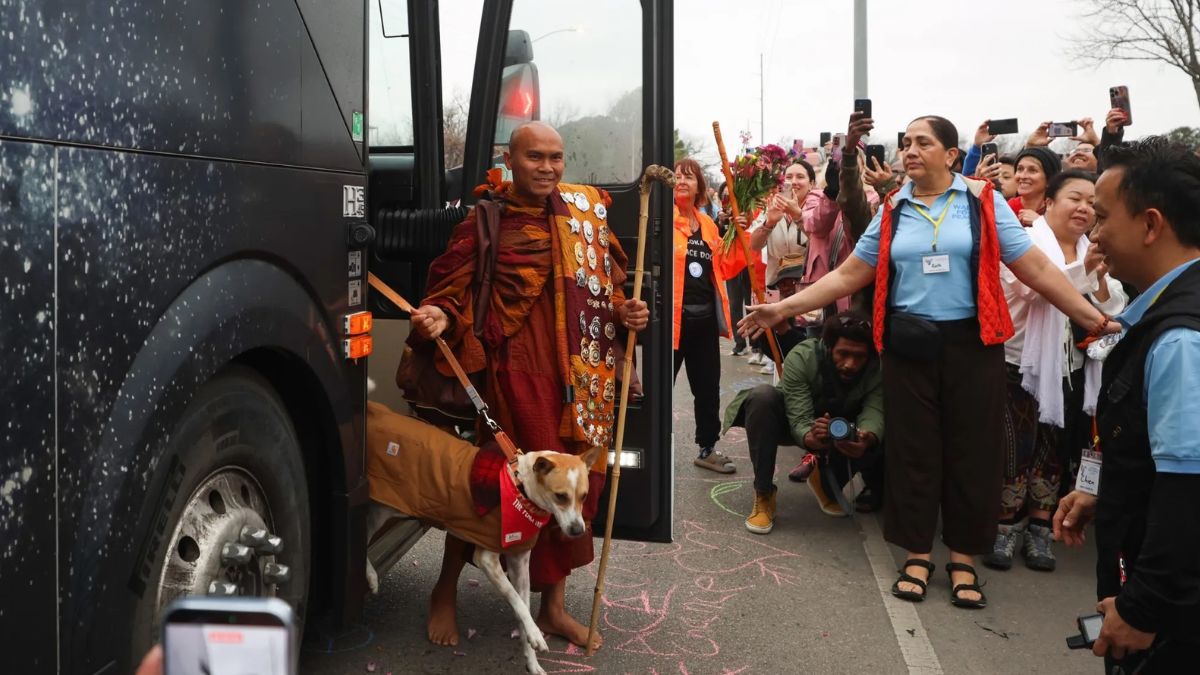
Somewhere on a freezing American highway in the winter of 2025, a remarkable sight began drawing the attention of passing motorists.
A line of saffron-robed Buddhist monks walked barefoot along the road, moving slowly and silently, one step at a time. But they were not alone. Walking alongside them was a lean, brown-and-white Indian street dog, keeping pace with the monks as snow and icy winds swept across the highway.
A small, heart-shaped white mark rested on his forehead.
Drivers slowed down to watch. Some pulled over. Strangers stepped out of their vehicles, holding flowers, bottles of water and treats. They had come to greet the monks, but increasingly, their attention turned towards the four-legged companion walking beside them.
His name was Aloka.
Just a few years earlier, he had been an anonymous street dog somewhere on the outskirts of Kolkata, surviving from one day to the next. He had no owner, no home and, until a group of Buddhist monks entered his life, apparently no name.
He could never have imagined that one day people across two continents would recognise him as the Peace Dog.
But perhaps the most extraordinary part of Aloka’s story is that he never set out to become one.
A street dog who refused to walk away
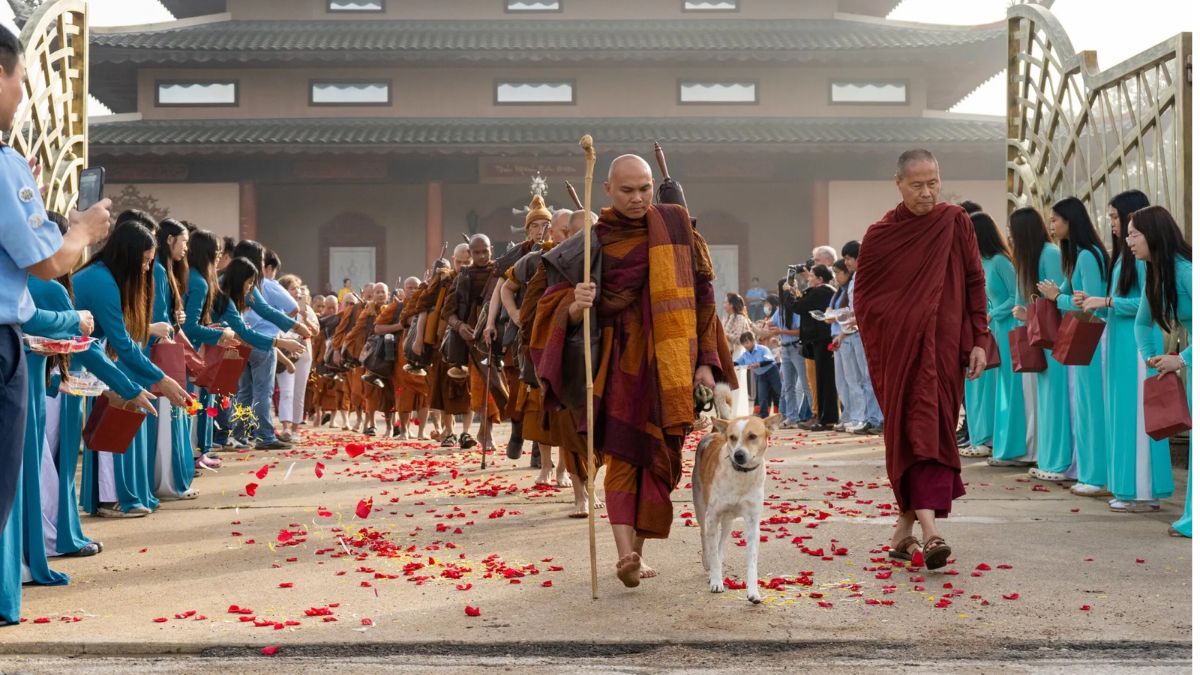
Aloka’s journey began around 2023 on the outskirts of Kolkata, India.
He was an Indian pariah dog, approximately two years old, living the uncertain life familiar to millions of street dogs across the country. There was no permanent shelter, no assured meal and no human being responsible for his safety.
Then, one day, a group of Theravada Buddhist monks passed through his world.
The monks were undertaking a 112-day pilgrimage across India and into Nepal. Among them was Vietnamese-American monk Venerable Bhikkhu Paññākara, who would eventually become closely associated with Aloka.
On the sixth day of their journey, near Kolkata airport, something unexpected happened.
A street dog began following them.
Initially, it probably did not seem particularly unusual. Dogs frequently follow people walking along roads, especially when they sense food or companionship. Other dogs joined the monks too, but most disappeared after a few hours or a day.
This one was different.
He kept coming back.
Through busy highways, scorching heat and heavy rain, the dog continued following the monks. He had no shoes, no supplies and no idea where the journey would end. Yet he seemed determined not to lose sight of the people he had chosen to accompany.
Then came an accident.
A car struck him, leaving him injured. Later, when he became seriously ill, the monks arranged for him to travel on a truck so that he could rest. But Aloka had other plans. He jumped off and returned to the walking group.
It was a moment that left a lasting impression on Paññākara.
“Many dogs follow us when we walk, but they usually drop out,” the monk later recalled. “Only him. Aloka kept coming back.”
The monk eventually carried the sick dog in his arms until he recovered.
By then, something had changed. What had begun as an unexpected encounter between a group of travelling monks and a homeless dog had grown into a remarkable bond.
They gave him a name: Aloka, a word in Sanskrit and Pali meaning ‘divine light’.
Paññākara has also spoken about his belief that Aloka might have been a monk in a previous life who broke his vows and was reborn as a dog. He chose the name because he wanted the animal to find the light of wisdom.
Whether one believes in reincarnation or not, the bond between the two was becoming impossible to ignore.
From Indian highways to a 2,300-mile American walk
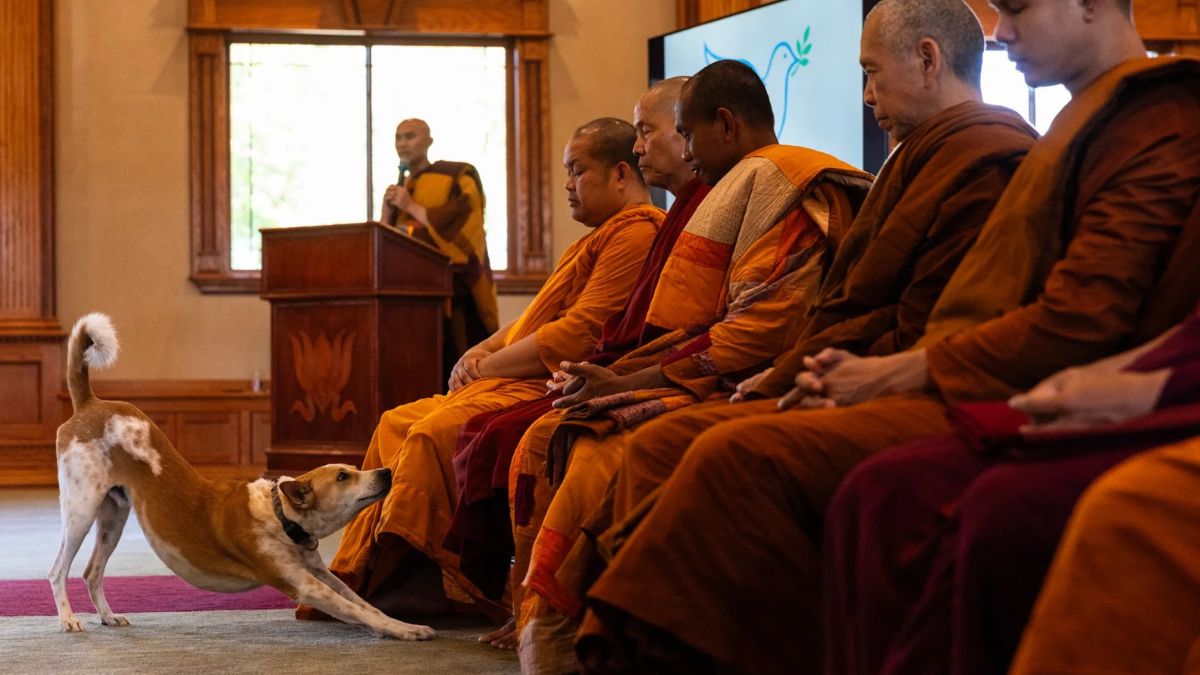
Years later, Aloka would find himself on another extraordinary journey, this time thousands of miles away from the streets where his story began.
On 26 October 2025, approximately 19 Buddhist monks set out from Fort Worth, Texas, on a journey they called the Walk for Peace.
Their destination was Washington, D.C., nearly 2,300 miles (3,700 kilometres) away.
The plan was to complete the journey in 108 days, with the number 108 carrying deep spiritual significance in Buddhism.
The walk began in Fort Worth’s Stop Six neighbourhood. It was not intended to be a political march, a public demonstration or a religious parade. Instead, Paññākara described it as an effort to spread awareness of peace, compassion and mindfulness in a world increasingly troubled by conflict and division.
Aloka was part of the journey.
The monks walked in single file, often barefoot, treating each step as a form of moving meditation. They carried very little and depended largely on the generosity of people they encountered along the way.
At stops along the route, they offered blessings, exchanged smiles and distributed thousands of peace bracelets. Paññākara encouraged people to carry a simple thought into their everyday lives:
“Today is going to be my peaceful day.”
For those watching from the roadside, however, there was another powerful message unfolding.
There was something unusual about seeing a dog walking so faithfully beside people who had chosen a life of simplicity and spiritual discipline. He did not understand the speeches, the religious teachings or the significance of the destination. Yet he seemed to embody the very qualities the monks were trying to communicate: patience, loyalty and perseverance.
The journey was far from easy.
In November, near Dayton, Texas, a truck struck the monks’ escort vehicle. Two monks suffered serious injuries, and one lost part of a leg.
Aloka also faced his own physical struggle. An injury to a ligament in his leg eventually required surgery in South Carolina.
For a while, the dog who had refused to leave the monks behind had to stop walking.
But he recovered.
And when he was ready, he returned to the journey, walking through snow, freezing temperatures and long stretches of American highway. The group covered approximately 20 to 23 miles a day.
Paññākara once offered a simple observation about Aloka’s determination.
“When I feel pain in my feet, I only have two feet,” he said. “He has four… and he still wants to walk. That gives us more strength.”
It was perhaps one of the most touching reminders of why Aloka had become such an important part of the pilgrimage.
The dog who became America’s unexpected symbol of peace
As the monks travelled across the United States, something neither they nor Aloka could have anticipated began happening.
People started gathering in increasingly large numbers.
In towns and cities along the route, residents waited for hours to catch a glimpse of the saffron-robed monks. Local authorities issued proclamations, police departments presented Aloka with honorary patches, and communities organised welcomes for the walking group.
But the dog was becoming a story of his own.
His distinctive heart-shaped forehead marking made him instantly recognisable. Photographs and videos of him walking beside the monks spread rapidly across social media.
People began calling him the Peace Dog.
By January 2026, the Walk for Peace’s Instagram and Facebook accounts had each crossed the million-follower mark. Aloka’s own online following was also growing rapidly.
For many Americans, the sight of this little Indian street dog walking through a country divided by political disagreements, social tensions and everyday anxieties carried a message that needed no translation.
He was not making speeches. He was not asking anyone to agree with him. He was simply walking.
And perhaps that was precisely why people connected with him.
Paññākara, however, did not consider Aloka a mascot or a publicity attraction.
“This is his mission, just like us,” he said.
Washington, D.C.: A journey reaches its destination
On 10 February 2026, after more than three months on the road, the monks finally arrived at Washington National Cathedral.
Thousands of people had gathered to welcome them.
For a group that had spent months walking through highways, towns and unfamiliar communities, reaching the American capital was a remarkable moment. Yet the message delivered by Paññākara remained consistent with the spirit of the pilgrimage.
They had not walked thousands of miles to bring peace to people, he explained. They had walked to raise awareness of the peace that already exists within each individual.
The following day, the journey continued to the Lincoln Memorial, where a closing ceremony was held.
Aloka was there too.
The monks also called upon Congress to recognise Vesak, the Buddhist observance commemorating the birth, enlightenment and passing of Gautama Buddha, as a federal holiday.
But beyond the formal proceedings and public attention, the deeper message of the walk remained simple: slow down, look within and rediscover compassion.
For Aloka, the destination was another milestone in a journey that had begun without a map, a plan or even a name.
The return home, and a hero’s welcome
After completing the walk, the monks did something that might seem rather amusing after travelling nearly 2,300 miles on foot.
They boarded a bus.
Their return journey to Fort Worth was by road rather than another long walk.
On Valentine’s Day, 14 February 2026, the group arrived back in east Fort Worth to a celebratory welcome. Residents greeted them with rose petals, traditional lion dances and chants.
The journey had come full circle.
But Aloka’s story was not finished.
In June 2026, he returned briefly to India, the country where he had once been just another homeless dog searching for food and shelter.
This time, the reception was very different.
Hundreds of animal lovers and activists gathered in Gurugram and Delhi to catch a glimpse of him. Flowers, celebrations and expressions of national pride greeted the dog who had travelled from Indian streets to become an internationally recognised symbol of peace.
Among those who met him was Maneka Gandhi, former Union minister and prominent animal-rights activist.
For many Indians, particularly those who care deeply about the country’s indigenous dogs, Aloka’s return carried a significance beyond celebrity or public recognition.
An Indian street dog had received affection and admiration on two continents.
The same dogs that are frequently overlooked, chased away or treated as a nuisance had found an unlikely ambassador.
Aloka’s journey had become a reminder that dignity and compassion should not depend on pedigree, ownership or social status.
More than a story about a dog
There are countless stories of animals demonstrating extraordinary loyalty to human beings. Some wait for years for owners who never return. Others travel incredible distances to find their families. Many quietly become companions to people who have little else in life.
Aloka’s story is different in one important respect.
Nobody appears to have asked him to join the monks. Nobody promised him a comfortable home or a reward at the end of the road. He simply chose to follow, and when the journey became difficult, he kept returning.
Perhaps that is what makes his story so powerful.
He represents loyalty without expectation, resilience without complaint and companionship without conditions.
There is also something deeply moving about the contrast between his beginnings and his eventual journey. A dog who once depended on the streets of Kolkata for survival ended up walking through some of America’s most recognisable landmarks, welcomed by thousands of strangers.
And beside him was a former engineer who had given up his possessions to devote himself to a spiritual journey.
Their paths crossed by chance, but what followed became an extraordinary story of trust between two very different beings.
We often speak about peace as something that requires grand speeches, political agreements or historic decisions. Yet sometimes its simplest expression can be found in the smallest gestures: offering water to a stranger, caring for an injured animal, walking beside someone who cannot keep up, or choosing kindness when indifference would be easier.
Aloka never delivered a sermon. He never held a placard or called upon the world to change.
He just kept walking.
From the dusty roads outside Kolkata to the frozen highways of America, and eventually to the steps of the Lincoln Memorial, an ordinary Indian street dog reminded millions that compassion does not need a language, a nationality or even two legs.
Sometimes, it arrives on four paws.
May all beings be well, happy and at peace.